

Where Can I Find Dimensional Drawing Of Flak 37?
| 8.8 cm Flak 18-36 | |
|---|---|
 eight.eight cm Flak 36 with Flak Rohr xviii barrel at the Imperial State of war Museum in London | |
| Type | Anti-aircraft gun |
| Identify of origin |  Nazi Germany Nazi Germany |
| Service history | |
| In service | 1936–1945 (Nazi Federal republic of germany) |
| Used by |
|
| Wars |
|
| Production history | |
| Designer | Krupp |
| Designed | 1928 |
| Manufacturer | Krupp, Rheinmetall |
| Unit cost | 33,600 RM[2] |
| Produced | 1933–1945 |
| No. built | 21,310[ citation needed ] |
| Specifications (Flak 36[iv]) | |
| Mass | vii,407 kg (16,330 lb) in mounted position |
| Length | 5.791 thou (20 ft) |
| Barrel length | 4.938 1000 (16 ft 2 in) (56 calibers) |
| Width | 2.3 m (7 ft 7 in)[3] |
| Height | ii.10 m (6 ft 11 in) (firing) |
| Crew | x[3] |
| | |
| Shell | Stock-still QF 88×571mmR[iii] |
| Caliber | 88 mm (three.46 in) |
| Barrels | Ane, 32 grooves with right-mitt increasing twist from 1/45 to ane/30 |
| Breech | Horizontal semi-automatic sliding block |
| Recoil | Hydro-pneumatic[iii] |
| Carriage | Sonderanhänger 201 (Flak 18) and Sonderanhänger 202 (Flak 36, 37, 41) |
| Pinnacle | −3° to +85° |
| Traverse | 360° |
| Charge per unit of fire | 15–20 rpm |
| Muzzle velocity | 840 chiliad/s (2,690 ft/south) |
| Constructive firing range |
|
| Maximum firing range | 9,900 m (32,500 ft) maximum ceiling |
| Sights | ZF.twenty |


The eight.8 cm Flak 18/36/37/41 is a German 88mm anti-aircraft and anti-tank artillery gun, developed in the 1930s. It was widely used by Germany throughout World State of war Two and is one of the nigh recognized German weapons of that conflict. Evolution of the original model led to a wide variety of guns.
The proper name applies to a series of related guns, the first one officially called the eight.8 cm Flak 18 , the improved viii.8 cm Flak 36 , and later the 8.eightcm Flak 37 .[N i] Flak is a contraction of German Flugabwehrganone (also referred to as Fliegerabwehrkanone)[5] [Northward 2] meaning "shipping-defence cannon", the original purpose of the weapon. In English language, "flak" became a generic term for ground anti-aircraft burn down. In informal utilise, the guns were universally known as the Acht-acht ("viii-eight") by Germans and the "80-eight" past the Allies.[Due north 3]
Air defence units were usually deployed with either a Kommandogerät ("command device") fire command computer or a portable Würzburg radar, which were responsible for its high level of accuracy against aircraft.
The versatile carriage immune the 8.8 cm Flak to be fired in a limited anti-tank style when still on its wheels;[4] it could be completely emplaced in merely ii and a half minutes.[4] Its successful apply equally an improvised anti-tank gun led to the development of a tank gun based upon it: the eight.viii cm KwK 36, with the "KwK" abbreviation standing for Kampfwagen-Kanone (literally "battle vehicle cannon", or "fighting vehicle cannon"), meant to exist placed in a gun turret as the tank's master armament. This gun served as the master armament of the Tiger I heavy tank.
In addition to these Krupp designs, Rheinmetall later created a more than powerful anti-shipping gun, the eight.eight cm Flak 41 ,[Northward ane] which was produced in relatively small numbers. Krupp responded with another image of the long-barreled viii.viii cm gun, which was further developed into the anti-tank and tank destroyer 8.viii cm PaK 43 gun used for the Elefant and Jagdpanther, and turret-mounted viii.8 cm KwK 43 heavy tank gun of the Tiger II.
Development history [edit]
Background [edit]

Earth State of war I Democracy troops with a captured, German 8.8 cm Flak 16 anti-aircraft cannon, Baronial 1918
Initially, anti-aircraft artillery guns of World War I were adaptations of existing medium-caliber weapons, mounted to let fire at higher angles. By 1915, the German command realized that these were useless for annihilation beyond deterrence, even confronting the vulnerable balloons and slow-moving aircraft of the period.[9] With the increment of aircraft performance, many armies adult dedicated AA guns with a high muzzle velocity – assuasive the projectiles to reach greater altitudes. It was this muzzle velocity, combined with a projectile of high weight, that made the 8.8 cm Flak one of the groovy World State of war II anti-tank guns.[x] The starting time such German gun was introduced in 1917, using the 8.8 cm caliber mutual in the Kaiserliche Marine (navy).[9]
Afterward losing the war, Germany had been forbidden under the terms of the Treaty of Versailles from procuring new weapons of most types. Nevertheless, the Krupp company started the development of a new gun together with Bofors of Sweden. Krupp had the majority ownership in Bofors since 1921. The original design was a 75 mm model.[9] During the prototype stage, the army asked for a gun with considerably greater capability. The designers started again, using 88 mm quotient.
Epitome 88s were beginning produced in 1928. This early model, the Flak 18, used a single-slice barrel with a length of 56 calibers, leading to the usually seen designation 50/56.
First generation: Flak 18, 36 and 37 [edit]

8.8cm Flak 36 being emplaced, with both bogies already discrete
The Flak 18 was mounted on a cruciform gun railroad vehicle. A simple-to-operate "semi-automatic" loading system ejected fired shells, allowing it to be reloaded by simply inserting a new shell into a tray. The gun would and then fire and recoil; during the return stroke, the empty example would exist thrown backward by levers, after which a cam would appoint and recock the gun. This resulted in firing rates of 15 to 20 rounds a infinitesimal, which was better than similar weapons of the era.[ citation needed ] High explosive ammunition was used confronting aircraft and personnel, and armour-piercing and high-explosive anti-tank against tanks and other armored vehicles.
Widespread production started with the Nazi ascension to power in 1933, and the Flak 18 was available in small numbers when Germany intervened in the Spanish Civil State of war. It quickly proved to exist the best anti-aircraft weapon then available.[ citation needed ] The flak detachment with 88s proved accurate and versatile in combat against mainly country targets, the high muzzle velocity and large quotient making information technology an excellent long-range anti-vehicle and anti-bunker weapon. This feel also demonstrated a number of pocket-sized issues and potential improvement opportunities.
The Flak 18's carriage allowed it to fire in an emergency when yet on its wheels and without its outriggers, just with a very limited traverse and elevation.[iv] For normal emplacement, one single-axle bogie was detached from the front end outrigger and one from the rear, side outriggers were so hinged from the vertical position to the ground; the total time to set up was estimated at two and a one-half minutes.[four] Both modes of performance made the gun much more suitable for fast-moving operations, the basic concept of the blitzkrieg. The weight of the gun meant that only large vehicles could move information technology, the Sd.Kfz. vii one-half-rails condign a common prime mover.
Targeting indicators were attached to the central controller to each of the iv guns of a bombardment, allowing for coordinated burn down. Indeed, with the automatic loading system, the gun layers' job was to keep the gun barrel trained on the target expanse based on the signals from the controller. The loaders would keep the weapon fed with live armament which would fire immediately upon insertion—all while the gun layer aimed the weapon co-ordinate to the data.

North Africa, 8.8cm Flak xviii towed behind a Sd.Kfz. 7, with its side outriggers lifted for transport visible backside the gun shield
Many of these improvements were incorporated into the Flak 36, which had a two-piece barrel for easier replacement of worn liners. Flak 36s were ofttimes fitted with an armoured shield that provided limited protection for the gunners. These shields could be retro-fitted on older Flak 18s likewise.
The afterward model was the Flak 37, which included updated instrumentation to allow the gun layers to follow directions from the single director more easily. In some sources it is mistakenly stated that the Flak 37 was non equipped for anti-armor operation. In fact all 8.eight cm Flak guns were capable of performance in the dual role.[eleven]
The parts of the various versions of the guns were interchangeable, and it was non uncommon for various parts to be "mixed and matched" on a particular instance.
Both Flak 18 and Flak 36 had the same permanently attached fuze setter with two "Zünderstellbecher". The Flak 37/41 had the simplified fuze setter of the 8.8-cm Flak 41.
2d generation: Flak 41 [edit]

As early as 1939 the Luftwaffe asked for newer weapons with an even improve performance, to accost the issues of defending against assail by loftier-flying aircraft. Rheinmetall responded with a new 88 mm design with a longer cartridge and a longer barrel.[12]
A prototype was ready in early 1941[12] leading to the designation 8.8 cm Flak 41. The new gun fired a 9.four-kilogram (xx lb) shell at a muzzle velocity of 1,000 m/s (iii,280 ft/south), giving information technology an effective ceiling of xi,300 meters (37,100 ft) and a maximum of 14,700 meters (48,200 ft), which Full general der Flakartillerie Otto Wilhelm von Renz said to exist "about equal to the 128-mm."[9] Information technology featured a lower silhouette on its turntable mounting than did the 8.viii-cm Flak 18/36/37 on its pedestal mounting. The barrel was at start a three-section i with a length of 74 calibers, and then redesigned to dual-department with a length of 72 calibers.[12] Improvements in reloading raised the firing rate, with 20 to 25 rounds a minute being quoted.[9]
Because of problems in service, the guns were almost exclusively used in Germany where they could be properly maintained and serviced. The Flak 41 had the disadvantage of complication, and was prone to problems with armament, empty cases oft jamming on extraction. Because of the high price and complexity of this weapon, the Germans manufactured relatively few of them, 556 in all. The kickoff deliveries were fabricated in March 1943[12] and, as of August 1944, merely 157 were fielded; with 318 in Jan 1945.[13]
Given very low production numbers and ongoing bug with the Flak 41, attempts were made to install the Flak 41 barrel onto other guns' chassis. During 1942 tests were made using the Flak 41 barrel and Flak 37 chassis only these identified that the chassis could not accept the strain fifty-fifty when strengthened. Work then continued using a Flak 37 barrel re-chambered for the Flak 41 round and with a muzzle brake. Subsequently other parts were strengthened this functioned equally desired. The resulting piece was 74 calibers long (78 with the muzzle brake). Problems with the multi-office butt construction of the Flak 37 were encountered and a new barrel based on the monoblock construction of the Flak xviii was designed. Production was cancelled afterward approximately only 13 units were congenital as the resources required to build these were similar to those needed to produce a true Flak 41 and those were but no longer available at the time.[thirteen]
A further effort was made to utilise a Flak 41 butt on an existing mount from the 10.5 cm FlaK 39. The resulting unit outperformed the 105 mm original and was chosen the 8.8 cm Flak 39/41. However, product did not take place as no Flak 41 barrels were available.[13]
Product history [edit]
Thousands of 88 mm guns were produced throughout the war in diverse models and mounts.
| pre-war | 1939 | 1940 | 1941 | 1942 | 1943 | 1944 | 1945 | Total | |
|---|---|---|---|---|---|---|---|---|---|
| 8.8 cm Flak 18/36/37[2] [14] | 2,459 | 183 | i,130 | 1,998 | iii,052 | 4,712 | 6,482 | 738 | 20,754 |
| 8.8 cm Flak 41[9] | 0 | 0 | 0 | 0 | 48 | 122 | 290 | 96? | 556 |
| 10.5 cm Flak 38/39[14] | ? | 38 | 290 | 509 | 701 | i,220[nine] | 1,331[nine] | 92 | more than 4,181 |
| 12.8 cm Flak 40 (including twins)[nine] [14] | 0 | 0 | 0 | 0 | 65 | 298 | 664 | 98 | 1,125 |
Compared to other arms types, German industry built for example, 570 heavy (quotient 88–128 mm) flak guns, 1,020 field arms pieces (caliber 75–210 mm), and 1,300 tank guns, anti-tank guns, plus cocky-propelled guns in Dec 1943.
Combat history [edit]
[American troops] knew that the greatest single weapon of the war, the atomic bomb excepted, was the German language 88 mm flat-trajectory gun, which brought down thousands of bombers and tens of thousands of soldiers. The Allies had null every bit good, despite ane of them designating itself the earth's greatest industrial ability.
German use [edit]
The 88 mm was used in 2 master roles: as a mobile heavy anti-aircraft and as an anti-tank gun. Other uses included firing in back up of the troops at the front and as a more static anti-aircraft gun for home defence.
Anti-aircraft defense of the Reich [edit]

Kommandogerät 40, the rangefinder and mechanical analog computer for directing anti-aircraft guns, Manege Military Museum, Helsinki, Finland (2006)
After 1935, the anti-aircraft defense of Federal republic of germany was controlled by the Luftwaffe.[nine] By the first of Globe War Two the Luftwaffe 's anti-aircraft artillery employed six,700 light (ii cm and 3.7 cm) and two,628 heavy flak guns. Of the latter, a small number were 10.five cm Flak 38s or 39s, the majority were eight.viii cm Flak 18s, 36s or 37s.[ix] This was twice every bit many heavy AA guns every bit RAF Fighter Command had at the time, with France and the United States having even fewer.[9]
Throughout the entire war, the bulk of 88 mm guns were used in their original anti-aircraft role.[ix]
The guns were usually equipped with a Kommandogerät system, which was an analog gunnery computer. The Kommandogerät systems were introduced starting in 1925, and the Kommandogerät p40 was the standard system during the majority of the war. It immune extremely precise burn down, and would even take into account how far abroad the guns were from one another and the aiming crew, cancelling out the get-go and aiming all weapons at the same signal. This allowed multiple guns to be aimed precisely at the aforementioned target by a single command crew of five men, instead of requiring trained crews on each gun.[17]
Radar aiming systems were as well developed to complement these systems. The Würzburg radar serial of radars was produced in the thousands and used widely. Information technology allowed general area fire without line of sight, but had poor accuracy compared to the visual systems. This resulted in the Giant Würzburg, which had sufficient accurateness to precisely control guns without straight visual contact.
The financial costs associated with anti-aircraft cannon were substantial, especially when compared with fighter aircraft.[ix] For instance, in January 1943 – at a time when Germany was desperately fighting to regain the strategic initiative in the Eastward and was also facing a heavy bombing campaign in the Due west – expenditures on anti-aircraft defenses were 39 million reichsmarks, whereas all the remaining weapons and munitions product amounted to 93 million (including 20 million of the navy budget and simply nine million of the aircraft-related budget).[nine]
By August 1944, there were x,704 Flak 18, 36 and 37 guns in service, now complemented also by the 10.5 cm Flak 38 and 39, and the formidable 12.8 cm Flak xl, owing to the increase in US and British bombing raids during 1943 and 1944. There were complaints that, due to the apparent ineffectiveness of anti-shipping defenses every bit a whole, the guns should be transferred from air defense units to anti-tank[ citation needed ] duties, but this politically unpopular move was never made.[ commendation needed ]
Support of ground troops [edit]

The 8.8 cm Flak performed well in its original function of an anti-aircraft gun and it proved to be a superb anti-tank gun besides.[15] An American tanker who survived losing three tanks wrote to Chrysler afterwards 5-Due east Day that "an 88 sure makes quick piece of work of them. They go through them just like they were a piece of paper".[18] Its success was due to its versatility: the standard anti-aircraft platform immune gunners to depress the muzzle below the horizontal, dissimilar most of its contemporaries. As WW2 progressed, it was becoming increasingly clear that existing anti-tank weapons were unable to pierce the armor of heavier enemy tanks and ground commanders began increasingly to use the 8.eight cm Flak against tanks.
Similarly to the anti-aircraft part, every bit an anti-tank weapon the viii.viii cm Flak was tactically arranged into batteries, unremarkably four guns to each. The college-level tactical unit of measurement was usually a mixed anti-aircraft battalion (gemischte Flak-Abteilung).[Northward 4] It totaled 12 such guns on boilerplate, supplemented past light guns.
The German Condor Legion made extensive utilise of the 8.viii cm Flak 18 in the Spanish Civil State of war, where its usefulness equally an anti-tank weapon and general artillery slice exceeded its function as an anti-aircraft gun. For the Battle of France in 1940, the regular army was supported past eighty-eights deployed in 20-4 mixed flak battalions.[9] The viii.viii cm Flak was used against heavily armored tanks such every bit the Char B1 bis and Matilda II, whose frontal armour could not be penetrated past the standard lite iii.7 cm anti-tank gun. The 8.8 cm Flak was powerful enough to penetrate over 84 mm of armor at a range of 2 km, making it an unparalleled anti-tank weapon during the early days of the war and notwithstanding formidable confronting all just the heaviest tanks at the cease.[19] Erwin Rommel's apply of the gun to edgeless the British counterattack at Arras ended any hope of a breakout from the encirclement of May 1940. In the entire Battle of France, the weapon destroyed 152 tanks and 151 bunkers.[nine] The Battle of France as well saw the introduction of vehicle-mounted 8.eight cm Flak 18s, the so-called "Bunkerknacker" on the Sd.Kfz. 8 heavy tractor.

Manhandling an 88 on the Russian front
During the North African entrada, Rommel made the most effective use of the weapon, equally he lured tanks of the British Eighth Army into traps by baiting them with apparently retreating German panzers. A mere 2 flak battalions destroyed 264 British tanks in 1941.[9] Repeated loftier tank loss from well-placed viii.viii cm Flak guns in the battles of Halfaya Pass earned it the nickname "Hellfire Pass". Later in that theater, in the Battle of Faid in Tunisia, Rommel camouflaged many 8.8 cm Flaks (with additional 7.5 cm Pak 40s and v cm Pak 38s) in cactus-filled areas. Inexperienced U.Southward. tankers and commanders rushed into a valley at Faid merely to be obliterated. When the U.S. Army'south M3 Stuart and M4 Sherman tanks pursued, concealed German language guns picked them off at ranges far beyond those of their 37 mm and 75 mm guns respectively.
For Operation Barbarossa, the invasion of the Soviet Union, Germany deployed the 8.8 cm Flak in 51 mixed AA battalions.[xx] They were by and large[nine] Luftwaffe-subordinated units attached to the Heer at corps or army level, with approximately one battalion per corps.[21] The weapon saw continuous use on the eastern front. The advent of the outstanding T-34 and the later on KV tanks shocked the German language panzer crews and anti-tank teams, who could only penetrate the Soviet tanks' armor at extremely close range on the order of 200 yards when using the standard 37 mm and 50 mm guns, while the Russian 76 mm gun was constructive out to g yards.[22] [ citation needed ]

88 with coiffure, France, 1944
The 8.8 cm Flak in the anti-tank role was arguably almost effective in the flat and open terrain of Libya, Egypt and the eastern front end. The less open up terrain in Italy and Northern French republic was less suitable for long-range AT guns. The success of the German anti-tank weapons caused the Allies to have steps to defend against information technology in new tank designs.[ citation needed ] On July xviii and xix 1944 a Luftwaffe 8.8 cm anti-aircraft battery was re-purposed by then Major Hans von Luck to attack British tanks most Cagny taking role in Operation Goodwood. Twenty tanks were destroyed by these guns within the start few seconds and at to the lowest degree 40 tanks were knocked out past 8.8 cm Flaks during the engagement.[23] Only as important, the success of the 8.8 cm Flaks spawned the development of dedicated 8.8 cm quotient PAKs (see below) which were even more adept at anti-tank mission due to their lower silhouette design. By February 1945, in that location were 327 heavy anti-aircraft batteries facing the Blood-red Regular army, which was 21 percent of those used for anti-shipping defense.[9]
Littoral defence [edit]
On 14 September 1942, Flak-Abt. I./43 (Major Wegener) employed these guns against a commando landing raid called Operation Understanding by the British Purple Navy near Tobruk. Betwixt them, Italian 155 mm (6-inch) shore batteries and aerial attack the destroyer HMSSikh was then severely damaged that she sank while being towed past HMSZulu.
Use past other armed forces [edit]
Italy [edit]
In June 1939 Italy had credits of nearly 300 million Italian lire with Deutschland for the sale of processed materials, therefore the Ministro della Guerra (Ministry of State of war) proposed that these credits be paid with the sale of 50 batteries of 8.8 Flak (88/55 in the Italian nomenclature), equal to 300 guns with relative ammunition. While the proposal was accepted in principle, the German government stated that they did non have that quantity of pieces available, and then they paid off the debt in role with 8.8 cm Flak and partly with the 7.5 cm kanon (75/50 in the Italian name).[24] In the proposal presented by the High german government, the Italian supply of mechanical parts for anti-aircraft guns and anti-tank guns was also envisaged, so the production of components for artillery was started in the workshops Ansaldo in (Genoa and Pozzuoli) and OTO.[25] The batteries were supplied complete with a Zeiss firing station Mod. 36 and related auxiliary equipment.
The batteries began arriving in Italian republic a few days afterwards Italia entered the war, and were initially assigned in office to the Milizia Volontaria per la Sicurezza Nazionale (Voluntary Militia for National Security, MACA), for the protection of the Italian main cities and partly sent in Libya, for the protection of ports. Some groups were afterward assigned to mobile motorcycle sections. However it was immediately evident that the Regio Esercito (Italian Royal Ground forces) did not have at its disposal a tractor with characteristics suitable for towing this piece, given that the task was entrusted to Lancia 3Ro, without all-wheel drive. At the end of 1940, 44 pieces and relative firing stations were available. Starting from October 1942, several batteries, while remaining in German possession, were used by Italian personnel (officers and troops) for the protection of military infrastructures and cities, this do was further intensified in 1943, reaching more than than 100 batteries.[26] In addition to the cannons that arrived for the canals established in 1940, in 1943, 24 pieces and their tractors were transferred to Italy intended for equipping the 1ª Divisione corazzata "M" (1st Armored Division "1000"). The 88/55 in the Regio Esercito was used in its natural office, that is, as an anti-aircraft weapon, its utilise as an anti-tank cannon was limited to the theaters of Northern Africa (Libya and Tunisia) and but for a few gruppi autocampali (cocky-transported field artillery groups).
People's republic of china [edit]
In 1937, the Chinese Nationalist Government imported 20 Flak 18 guns and used them to defend the fortifications forth the Yangtze River. They were captured by the Japanese Purple Army during the Sino-Japanese State of war.[ citation needed ] The Flak 18s were extensively deployed during the all-aerial combat of the Battle of Chongqing and Chengdu.[27]
Republic of finland [edit]
In 1943–1944 Finland bought 90 8.8 cm FlaK 37 cannons from Germany and they were used for air defence of largest cities in Republic of finland. These cannons played an of import role against Soviet air raids in Helsinki in February 1944. After the war these cannons remained in Finnish use as AA-guns until 1977 and later that equally coastal guns until the early 2000s.[28] The gun had nickname Rämäpää ("Reckless") after the manufacturer'southward initials RMB. Several of the Finnish guns survive in museums and equally memorials.
Kingdom of spain [edit]
Four batteries (16 guns) of 88 mm guns (Flak xviii) initially reached Kingdom of spain as AA with the Condor Legion in 1936, but it was presently used every bit anti-tank, anti-bunker and even for counterbattery burn down. More guns were sent after, and some 88 mm guns were as well supplied to Spanish army units. At the end of the war the Spanish Army was using all of the Flak 18 guns sent, some 52 units.[ citation needed ]
Initially, the Flak eighteen batteries were deployed to protect the airfields and logistics bases of the German Condor legion. The scarcity of artillery among the Nationalist forces and the full general low proficiency of the Castilian gun crews forced the usage of the Flak eighteen gun in a variety of roles, including as an artillery slice and as an anti-tank gun. Given appropriate ammunition information technology proved quite capable in both roles.[29] The state of war in Spain, with its wildly fluctuating front lines and the presence of Russian tanks, forced the Germans to apply the Flak eighteen guns in a straight fire mode confronting footing targets. By the end of the war the 88 mm guns had performed far more than missions every bit an anti-tank and direct-fire Field Artillery gun than every bit an anti-aircraft gun. During the state of war German language 88 mm guns were involved in 377 combat engagements, only 31 were confronting enemy aircraft.[ citation needed ] The apply of the 88 mm in direct support of the infantry brought the gun crews in close proximity to the enemy and made the crews susceptible to infantry fire. Casualties among the legion'south 88 mm gun batteries in the Spanish Civil War were second merely to those among the bomber pilots.[ citation needed ]
In early on 1937 in the fighting effectually Malaga, a battery of 88 mm guns was assigned to support an infantry brigade. Bad weather grounded the main bomber forcefulness, but the assault succeeded, mainly considering of the concentrated and accurate burn down of the supporting 88 mm guns.[ citation needed ] Flak xviii batteries were used by the nationalist army at the Battle of Ebro, both for direct fire against pillboxes and likewise for indirect fire in the advance towards Barcelona.
Following the Spanish Ceremonious War, more Flak 36 models arrived in 1943 (88 guns 88/56 mm Flak-36) and since 1943 they were manufactured under license in Trubia under the denomination FT 44 (most 200 guns).[ citation needed ]
Allied [edit]
The Flak 36 guns were briefly issued in late 1944 to the American 7th Army equally captured weapons. The 79th Field Artillery Battalion (Provisional) was formed from personnel of the 79th and 179th Field Artillery Groups to burn captured German artillery pieces at the meridian of an ammunition shortage. Similarly, the 244th Field Artillery Battalion was temporarily equipped with a miscellany of captured German 88 mm guns and 105 mm and 150 mm howitzers. By December 31, 1944, the 244th Field Artillery Battalion had fired a full of x,706 rounds through captured German weapons.[30]
France [edit]
In March 1945, French republic equipped its 401st and 403rd Anti-Aircraft artillery regiment with captured German 8.8 guns, associated with British GL Mk. II and GL Mk. III radars.[31] The guns remained in service with second-line units until 1953 and then were used for training for a few years.[32]
Yugoslavia [edit]
During the Yugoslav wars in the 1990s, various Flak guns were used, mainly by the naval artillery of the Yugoslav People's Army (JNA). The Yugoslav Army (VJ) also used Flak carriages mounted with double 262 mm rocket launch tubes from the M-87 Orkan MLRS, instead of the 88 mm gun. It was capable of deploying cluster bombs, as well every bit anti-personnel and anti-tank mines, at up to fifty km. Only a few were built in mid-1993, the entire project was generally regarded as unsuccessful.[33]
Greece [edit]
Greece had at least 24 guns (8.eight) that were used against the Regia Aeronautica during the Italian invasion of Greece in 1940. Afterward these guns were used against the invading German forces in April 1941.
Vietnam [edit]
Beginning in 1954 the Democratic Republic of Vietnam received a number of Flak 88s from the Soviet Union. These cannons were used against The states fighter jets in the early 60s.
Comparing with like anti-aircraft guns [edit]
The Flak 18/36/37 was roughly comparable to its Italian and Allied counterparts. As an anti-aircraft gun information technology fired a 9.two kilogram (20 lb) shell at a muzzle velocity of 840 m/s to an effective ceiling of 8,000 meters,[34] with a maximum ceiling of 9900 meters.[iv] While this was potent against US daylight raids, which generally flew at altitudes of 6,400 to 7,600 one thousand (21,000 to 24,900 ft), some aircraft were able to fly higher than the gun's effective ceiling. Some flak batteries used guns worn out from firing across their operational lives, which typically limited their constructive ceiling to 7,470 m (24,510 ft).[35]
In comparison, the British QF 3.7-inch (94 mm) Mark Iii fired a xiii kg (29 lb) projectile at 790 m/s (2,600 ft/s) to an effective ceiling of 10,600 meters (34,800 ft), and the American ninety mm M1 fired a x kg (22 lb) shell at 820 m/s (ii,700 ft/s) to the same superlative, while the Italian Cannone da ninety/53 fired a 10.33 kg projectile at 830 k/southward to an constructive ceiling of 12,000 meters (39,000 ft). The Allied weapons' capabilities were augmented by the introduction of proximity fuzes. The Allies' and Italian weapons were heavier and less mobile, with the Allied weapons being almost useless for basis fire until numerous modifications were carried out.[ commendation needed ] While the United states of america and Italian ninety mm were also used as anti-tank guns—the American gun being in use on their M36 tank destroyer and M26 Pershing heavy tank—their employ was considerably more limited than the High german 88 due to German language tanks existence primarily used defensively past 1944 and Allied tanks being used en masse for the attack.
[edit]
8.8 cm KwK 36 [edit]
The KwK 36 (abbreviation of Kampfwagenkanone 36) was a tank gun developed and built by Krupp in parallel to the Flak 36, with which it shared ammunition and ballistics. It was the main armament of the Tiger I heavy tank.
viii.8 cm PaK 43 and KwK 43 [edit]

The PaK 43/41 used an intermediate split-trail mountain with gun shield, instead of the cruciform mount
At the time that Rheinmetall adult the Flak 41, Krupp tried to compete with their 8.8 cm Gerät 42 proposal, which was non accepted for production every bit an anti-aircraft gun. Krupp continued development, resulting in the dreaded 8.8 cm PaK 43 anti-tank gun and the related eight.eight cm KwK 43 tank gun.
The PaK 43 (an abridgement of Panzerjägerkanone 43 [36] [37]) used a new cruciform mount with the gun much closer to the basis, making it far easier to hibernate and harder to hit. It was besides provided with a much stronger and more angled armour shield to provide better protection to the crew. In add-on to the towed version, there were also self-propelled versions of the PaK 43 gun, including the lightly armored Nashorn, and the strongly armored, fully casemate-enclosed Elefant and Jagdpanther tank destroyers.
All versions were able to penetrate most 200 mm (7.ix inches) of armour at 1,000 m (3280 feet), assuasive it to defeat the armor of any gimmicky tank.
The principal armament of the Tiger 2 heavy tank, the KwK 43 tank gun, was the PaK 43 adjusted for tank use, and it was considered for the Panther II tank.
Versions [edit]
Guns using the 88×571R mm cartridge [edit]
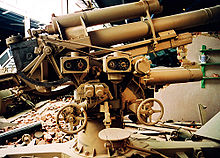
- 8.8 cm Flak eighteen Had a new semi-automatic breech, making it a rapid fire gun. It entered production in Federal republic of germany in 1933 and used the Sonderanhänger 201 trailer. its weight was vii tonnes. Its rate of fire was xv to twenty rounds per infinitesimal. It was afterwards fitted with a gun shield to protect the crew when engaging ground targets. It was produced past Krupp.
- Modernistic 1938 II: Approximately l guns were modified and then a unmarried man could adjust the meridian and traverse.
- eight.eight cm Flak 36 Entered service 1936–37. It used the redesigned trailer Sonderanhänger 202 which enabled a faster time into action from the move. The SdAnh 202 had twin wheels on two like carriages. It could appoint ground targets from the traveling position. Its weight was seven tonnes. Its charge per unit of fire was xv to xx rounds per minute. It was produced by Krupp. It was after fitted with a shield to protect the crew when engaging ground targets.
- 8.viii cm KwK 36: The principal gun of the Tiger I (PzKw Six Ausf. E) tank. Despite its lineage, some[ who? ] allocate information technology every bit a parallel development with very similar specifications rather than a derivative of the Flak 36.
- 8.8 cm Flak 37: It was an updated version of the Flak 36, the chief departure being Übertragungser 37 (a data manual system). It was produced by Krupp.
Guns using the 88×855R mm cartridge [edit]
- eight.8 cm Flak 41: This was a weapon developed and produced by Rheinmetall-Borsig to be used with an 855 mm cartridge case.[38] It was fitted to the existing Sonderanhänger 202 as standard and entered service in 1943. The barrel was at first designed equally three-section with a length of 74 calibers, and and so redesigned to dual-section with a length of 72 calibers.[12]
- 8.8 cm Flak 37/41: This weapon was an attempt to allow the Flak xviii/36/37 family unit to burn down the more than powerful round of the Flak 41. Only 13 built.
Surviving examples [edit]
The post-obit museums include 8.eight cm Flak guns in their collections.
Argentina [edit]
- National Naval Museum of Tigre
Australia [edit]
- Australian Armour and Arms Museum, Cairns
- Imperial Australian Armoured Corps Memorial and Army Tank Museum, Puckapunyal
- Australian State of war Memorial, Canberra
Austria [edit]
- Heeresgeschichtliches Museum, Vienna
Belgium [edit]
- Royal Museum of the Armed Forces and Armed services History, Brussels.
Canada [edit]
- Canadian State of war Museum, Ottawa.
- The Ontario Regiment Museum, Oshawa.
- Royal Military College of Canada, Kingston (PAK 43 and Flak 37).
Denmark [edit]
- Danish War Museum, Copenhagen.
Republic of finland [edit]
- Ilmatorjuntamuseo, Hyrylä
- Kuivasaari Arms Museum, Helsinki
- Kauppi woods, on top of Tuomikallio as a memorial, Tampere
- Lohtaja, army training expanse square - map link
France [edit]
- Le Grand Bunker "Musée du Mur de l´Atlantique", Ouistreham
- Musée de la Résistance bretonne, Saint-Marcel, Morbihan(Flak 18)
- Musée du Débarquement, Arromanches-les-Bains
- Musée des blindés, Saumur
Deutschland [edit]
- Deutsches Panzermuseum, Munster
- Aviation Museum Hannover-Laatzen
- Wehrtechnische Studiensammlung Koblenz
- Luftwaffenmuseum der Bundeswehr, Berlin-Gatow
- Deutsches Technikmuseum, Berlin
India [edit]
- Cavalry Tank Museum, Ahmednagar
Netherlands [edit]
- Overloon War Museum, Overloon
- Atlantikwall-Museum, Hook of Holland
- Bevrijdende Vleugels Museum, Best
New Zealand [edit]
- The Vintage Aviator (privately owned by Peter Jackson), Masterton
Kingdom of norway [edit]
- Trondenes Fort, Harstad
Poland [edit]

8.viii cm Flak 37 on the fortification mountain. Exhibit of Coastal Defence Museum in Świnoujście, Poland.
- Coastal Defence Museum in Świnoujście, Świnoujście
- Muzeum Śląskie (Silesian Museum), Katowice, Poland
Romania [edit]
- National Military machine Museum, Romania, Bucharest
Serbia [edit]
- Armed services Museum, Belgrade, Belgrade
Slovenia [edit]
- Pivka War machine Museum, Pivka
South Africa [edit]
- South African Museum of Military History Johannesburg
Spain [edit]
- Museo Histórico Militar, A Coruña[39]
- Flak 36 in Historical Military Museum of Cartagena (Spain)
- Museo Histórico Militar de Valencia
Great britain [edit]
- Imperial State of war Museum Duxford, Duxford
- Royal State of war Museum, London
- Royal Armouries, Fort Nelson, Hampshire
- Muckleburgh Collection, Norfolk
- High german Occupation Museum, Guernsey
United States [edit]
- Virginia War Museum, Newport News, Virginia. One 76 mm hole in outrigger.
- United states of america Regular army Air Defense Artillery Museum, Fort Sill, Oklahoma. (Flak 18, Flak 36, Flak 37, Flak 41, 8.8 cm Flak M39(r))
- National Museum of the United States Air Force, Dayton, Ohio[twoscore]
- The Flying Heritage Collection, Everett, Washington
- Military Aviation Museum Virginia Beach, Virginia (Flak 37 in working status)
- Palm Springs Air Museum, Palm Springs, California
- National WWII Museum, New Orleans, Louisiana
- two-FlaK 37, Private collection, J Bostek, Michigan www.709th.org
- Indiana Military Museum, Vincennes, Indiana, received from United Kingdom October 22, 2020 and beingness restored.
Gallery [edit]
-
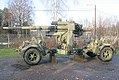
Flak 37 gun at the Anti-aircraft Museum in Hyrylä, Finland
-

8.viii cm High-explosive shell
-

Flak 36 gun in position at Bir Hakeim, North Africa, June 1942
-
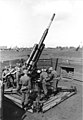
Flak 36 battery in firing position, Germany, 1943
-
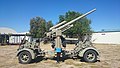
8.viii cm Flak 37 in Madrid, Spain
-

eight.viii cm Flak 37 in Tampere, Finland
-

viii.eight cm Flak 37 in Tampere, Republic of finland
See also [edit]
- Flak tower
- 8.viii cm SK C/30 naval gun: gimmicky High german Navy dual purpose anti-surface and anti-aircraft gun
Weapons of comparable part, performance and era [edit]
- Bofors 75 mm Model 1929: 75 mm and eighty mm Swedish gun developed aslope the 88 at Bofors
- QF three.vii-inch AA gun: contemporary British anti-shipping gun, firing a heavier (28 pounds (thirteen kg)) shell
- Cannone da ninety/53: gimmicky Italian anti-aircraft gun
- 90 mm Gun M1: contemporary The states anti-shipping gun
- 85 mm air defense gun M1939 (52-Grand): contemporary Soviet anti-aircraft gun
References [edit]
Explanatory notes [edit]
- ^ a b In German language, the comma is used as the decimal separator, hence official punctuation was actually "8,8 cm" and not "8.viii cm". The spoken version was Acht-komma-acht Zentimeter.
- ^ Also many sources say Flak is a contraction of Flugabwehrkanone [6] or Fliegerabwehrkanone or Flugzeug-Abwehr-Kanone.[7] In all cases, including the latter, the letter of the alphabet "k" in "Flak" was not capitalized, as information technology did non signify an abbreviation of the High german word Kanone.
- ^ The Allied slang for anti-aircraft fire, ack-ack, does not come up from the Acht-acht, simply is World State of war I signalers' phonetic spelling of letters "AA".[8]
- ^ The light anti-aircraft battalion unremarkably did non deploy any 8.8 cm Flaks, the heavy battalions were rarely used in practice.
Citations [edit]
- ^ a b Schuster, Carl O. (July 27, 2016). "The Ascent of North Vietnam'south Air Defenses". HistoryNet . Retrieved January 6, 2020.
- ^ a b "Fugabwehrwaffen" [Anti-aircraft weapons]. Lexikon der Wehrmacht (in German language). Retrieved May 6, 2020.
- ^ a b c d Foss, Christopher (1977). Jane's Pocket Book of Towed Artillery. New York: Collier. p. 49. ISBN0-02-080600-0. OCLC 911907988.
- ^ a b c d e f TM E9-369A: German 88-mm Antiaircraft Gun Materiel – Technical Transmission. U.S. War Department. June 29, 1943. Retrieved Dec 23, 2014 – via Lonely Sentry.
- ^ Biedermann, Westward. (1923). Die deutsche Sprache als Spiegel deutscher Kultur [The High german linguistic communication as a mirror of German culture] (in German). Frommannsche Buchhandlung. p. 38.
Flak (Flugzeugabwehrkanone)
- ^ Oberkommando des Heeres H.Dv.481/541 – Merkblatt für dice Munition der viii,viii cm Flugabwehrkanone eighteen (8,8 cm Flak xviii) und der 8,eight cm Flugabwehrkanone 36 (8,8 cm Flak 36). Berlin: Oberkommando des Heeres. 1942.
- ^ Wilhelm Oppermann, 1928.
- ^ Hinckley, Paul. "A Dictionary of Great State of war Slang". Old Contemptible'southward Great War Website. Archived from the original on July 20, 2011. Retrieved December 23, 2014.
- ^ a b c d e f m h i j k l m north o p q r due south t Westermann, Edward B. (2005–2009) [2001]. Flak: German Anti-aircraft Defenses 1914–1945. Modernistic War Studies. University Printing of Kansas. pp. 19, 36–38, 44, 53, 58, 83, 90, 108, 128–129. ISBN978-0-7006-1420-2.
- ^ "88mm Flak Series – Flugabwehrkanone". AchtungPanzer.com. Archived from the original on December 17, 2014. Retrieved Dec 23, 2014.
- ^ Chow, Roy (February half dozen, 2012). "Mistakes and Myths in High german viii.8cm Flak Identification". Rail-link.com . Retrieved October 8, 2014.
- ^ a b c d e Norris, John (Jan 1, 2002). 88 Mm FlaK eighteen/36/37/41 & PaK 43, 1936–1945: 1936–45. Bloomsbury USA. p. 15. ISBN978-ane-84176-341-5.
- ^ a b c Gander, Terry (July 19, 2012). German 88. Sword and Pen. ISBN978-1-84884-832-0.
- ^ a b c "German Weapon and Ammunition Production". Orbat.com. Archived from the original on June 14, 2011.
- ^ a b Fussell, Paul (Baronial 1989). "The Real War 1939-1945". The Atlantic . Retrieved July x, 2019.
- ^ Fussell, Paul (1989). Wartime: Understanding and Behavior in the Second Earth State of war . Oxford University Press. pp. 267–268. ISBN0-nineteen-503797-9. LCCN 89002875.
- ^ Nijboer, Donald (2019). High german Flak Defences vs Allied Heavy Bombers: 1942–45. New York City: Random House. ISBN978-i-47283-671-seven.
- ^ Stout, Wesley W. (1946). Tanks are Mighty Fine Things. Chrysler Corporation. p. 117. Retrieved July eleven, 2019.
- ^ Ankerstjerne, Christian. "Armor Penetration Table: Pzgr. 39 ammunition confronting a 30-caste sloped steel plate". Panzerworld.cyberspace.
- ^ Askey, Nigel (March 2011). "Chapter V-4: The Order of Boxing (OOB) of German Land Combat Units from 22nd June to fourth July 1941" (PDF). OperationBarbarossa.cyberspace. Archived from the original (PDF) on March 17, 2012. Retrieved July 24, 2011.
- ^ "Barbarossa Gild of Battle". Orbat.com. Archived from the original on April 18, 2012. Retrieved Dec 23, 2014.
- ^ Macksey, Kenneth (1971). Tank Warfare. St Albans: Panther. ISBN978-0-58604-302-8.
- ^ von Luck, Hans (1989). Panzer Commander. New York City: Dell Books. pp. 193–198. ISBN0-440-20802-v.
- ^ Cappellano 1998, p. 211.
- ^ Cappellano 1998, p. 216.
- ^ Cappellano 1998, p. 217.
- ^ 讲武堂, hawk26 (March 22, 2020). "In Defense of The Chongqing Sky: Chinese Anti-Aircraft Units Operating German Anti-Aircraft Guns in 1941". 网易 NetEase (in Chinese). Retrieved December viii, 2020.
In March 1941, Carl Mydans, lensman of the American magazine "Life", captured many images of China's wartime capital of Chongqing, which was brutally bombed for years by the Japanese. Through his photos, the world caught a glimpse of how Chinese soldiers and civilians dealt with and suffered under the massive circular-the-clock terror bombing campaign by the Imperial Japanese ... these are some of the photos of the Chinese elite anti-aircraft arms units.
{{cite web}}: CS1 maint: url-condition (link) - ^ "Finnish Army 1918–1945: AntiAircraft Guns Role iii". Jaegerplatoon.internet . Retrieved December 23, 2014.
- ^ "U.S. Military Intelligence Study: German Anti-Shipping Artillery" (PDF). February 8, 1943. p. 37. Retrieved February 4, 2015.
- ^ "History: December 1944". 244th Field Arms Battalion . Retrieved Dec 23, 2014.
- ^ Petit, Jean-Pierre. "Chapitre vii - Les FTA françaises dans la Reconquête". Base de données Artillerie (in French). Retrieved July 17, 2020.
- ^ Petit, Jean-Pierre. "Chapitre 9 - Équipements et recherches techniques d'après-guerre, en France". Base of operations de données Artillerie (in French). Retrieved July 17, 2020.
- ^ "Kalibar" No. 106, August 2005
- ^ Askey, Nigel (2014). Operation Barbarossa: the Complete Organisational and Statistical Analysis, and Military Simulation Volume IIB. Lulu Publishing. p. xc. ISBN978-1-31241-326-nine.
- ^ Westermann, Edward B. (2001). Flak: German language Anti Aircraft Defenses 1914–45. Academy Press of Kansas. p. 293. ISBN978-0-70061-420-2.
- ^ D 2030 – 8,eight cm Panzerjägerkanone 43/2 (50/71), Beschreibung, 28 January 1944. Berlin.
- ^ D97/1+ Geräteliste, Oberkommando des Heeres, Heereswaffenamt, s.45, Berlin 1.vii.43
- ^ Williams, Anthony G. "78-100 mm Calibre Cartridges". Ammunition Information Tables. Archived from the original on Nov 24, 2011. Retrieved July 30, 2011.
- ^ "Cañones para Hitler en A Coruña: el Monte de San Pedro". La Segunda Guerra.com . Retrieved December 23, 2014.
- ^ "Flak 36 88 mm Multipurpose Gun". National Museum of the Usa Air Force . Retrieved Baronial 5, 2015.
Bibliography [edit]
- Cappellano, Filippo (1998). Le artiglierie del Regio Esercito nella Seconda Guerra Mondiale (in Italian). Parma: Albertelli. ISBN8887372039.
- Chant, Christopher (2001). Artillery of World State of war II. London, U.k.: Chocolate-brown Partworks. ISBN1-84044-088-0.
Further reading [edit]
- Gander, Terry (Oct nineteen, 2009). German 88: The Most Famous Gun of the 2d Earth War. Pen and Sword Books Ltd. ISBN978-1848840409.
- Gander, Terry; Chamberlain, Peter (1979). Weapons of the Third Reich: An Encyclopedic Survey of All Small Arms, Arms and Special Weapons of the German language Country Forces 1939–1945. New York City: Doubleday. ISBN0-385-15090-3.
- Hogg, Ian 5. (1997). German language Artillery of World State of war Two (2nd corrected ed.). Mechanicsville, Penn.: Stackpole Books. ISBN1-85367-480-Ten.
- Piekalkiewicz, Janusz (1992). The German 88 Gun in Combat: The Scourge of Centrolineal Armor. translated by Edward Force. Schiffer Military machine History. ISBN978-0-88740-341-v.
External links [edit]
- The 88mm Gun: The Weapon Nazi Federal republic of germany Used to Destroy Everything
- History of the 88 mm serial of guns
- U.s.a. Armed services Intelligence document on the 88 mm gun
- The New 88 and Its Carriages
- Detailed examination of the effect of 88 mm FlaK on B-17 and B-24 bombers
- Technical Transmission German 88 mm Antiaircraft Gun Materiel – Usa War Department, 29 June 1943
- Extract from "Handbuch für den Flakartilleristen" – Dice viii.8 cm – Flak 1939

Source: https://en.wikipedia.org/wiki/8.8_cm_Flak_18/36/37/41
Posted by: brooksthenat1986.blogspot.com
0 Response to "Where Can I Find Dimensional Drawing Of Flak 37?"
Post a Comment