

What Are Reptile Bones Made Of What Is The Chemical Makeup Of Bone
Os Tissue and the Skeletal System
Bone Structure
Learning Objectives
Past the finish of this department, y'all will be able to:
- Identify the anatomical features of a os
- Define and listing examples of bone markings
- Describe the histology of bone tissue
- Compare and contrast compact and spongy bone
- Identify the structures that compose meaty and spongy bone
- Depict how basic are nourished and innervated
Bone tissue (osseous tissue) differs greatly from other tissues in the trunk. Bone is hard and many of its functions depend on that feature hardness. Subsequently discussions in this chapter will prove that bone is also dynamic in that its shape adjusts to accommodate stresses. This department will examine the gross anatomy of bone first so move on to its histology.
Gross Anatomy of Bone
The structure of a long bone allows for the best visualization of all of the parts of a bone ((Figure)). A long os has ii parts: the diaphysis and the epiphysis. The diaphysis is the tubular shaft that runs betwixt the proximal and distal ends of the os. The hollow region in the diaphysis is chosen the medullary cavity, which is filled with yellow marrow. The walls of the diaphysis are composed of dense and hard compact bone.
Anatomy of a Long Bone
A typical long bone shows the gross anatomical characteristics of os.
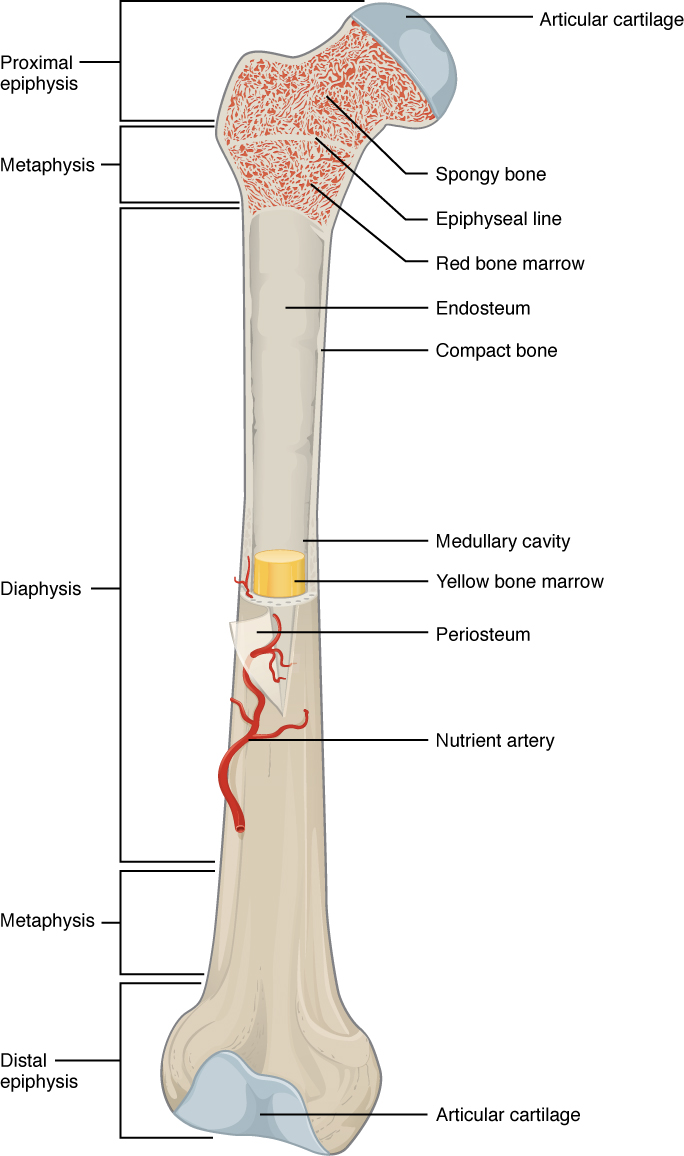
The wider section at each end of the bone is called the epiphysis (plural = epiphyses), which is filled with spongy os. Red marrow fills the spaces in the spongy bone. Each epiphysis meets the diaphysis at the metaphysis, the narrow expanse that contains the epiphyseal plate (growth plate), a layer of hyaline (transparent) cartilage in a growing os. When the os stops growing in early machismo (approximately xviii–21 years), the cartilage is replaced by osseous tissue and the epiphyseal plate becomes an epiphyseal line.
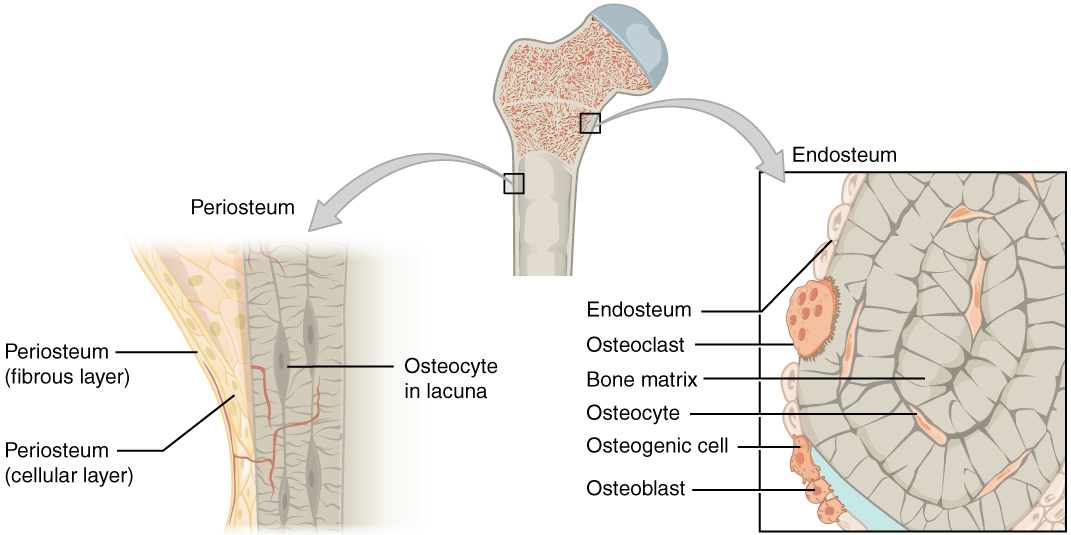
The medullary cavity has a delicate bleary lining called the endosteum (end- = "inside"; oste- = "bone"), where bone growth, repair, and remodeling occur. The outer surface of the bone is covered with a gristly membrane called the periosteum (peri– = "around" or "surrounding"). The periosteum contains claret vessels, fretfulness, and lymphatic vessels that nourish compact bone. Tendons and ligaments also attach to bones at the periosteum. The periosteum covers the unabridged outer surface except where the epiphyses meet other basic to form joints ((Figure)). In this region, the epiphyses are covered with articular cartilage, a sparse layer of cartilage that reduces friction and acts equally a daze cushion.
Periosteum and Endosteum
The periosteum forms the outer surface of bone, and the endosteum lines the medullary cavity.
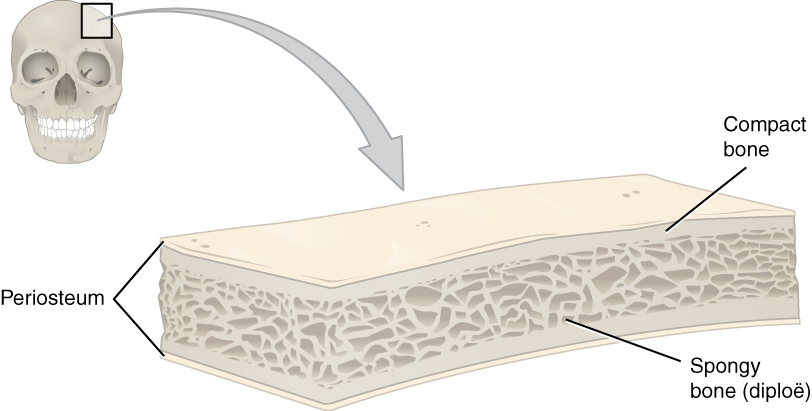
Flat bones, like those of the cranium, consist of a layer of diploë (spongy bone), lined on either side by a layer of compact bone ((Figure)). The two layers of compact bone and the interior spongy os work together to protect the internal organs. If the outer layer of a cranial bone fractures, the encephalon is still protected by the intact inner layer.
Beefcake of a Flat Os
This cross-section of a flat bone shows the spongy bone (diploë) lined on either side past a layer of compact bone.
Bone Markings
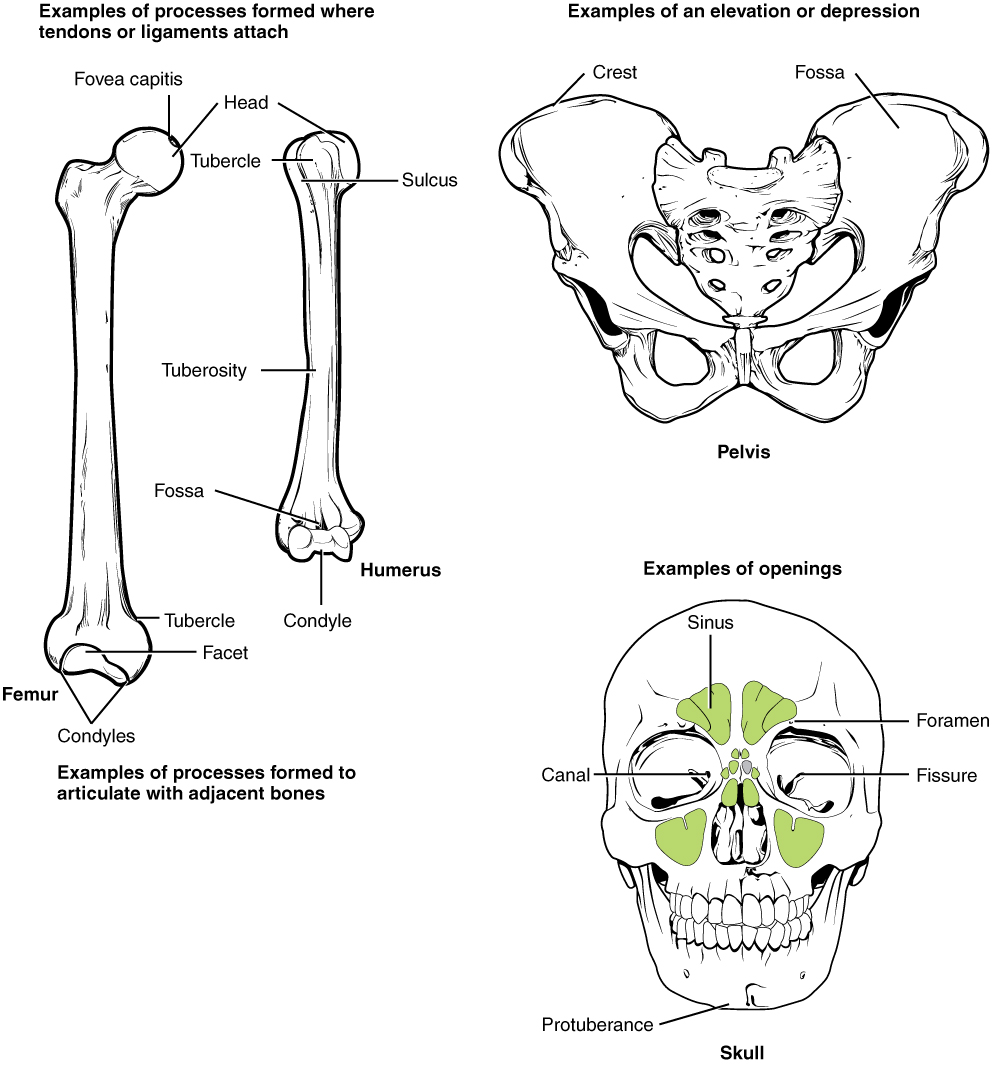
The surface features of bones vary considerably, depending on the function and location in the body. (Figure) describes the bone markings, which are illustrated in ((Figure)). There are 3 general classes of bone markings: (1) articulations, (2) projections, and (3) holes. As the proper name implies, an articulation is where two bone surfaces come together (articulus = "joint"). These surfaces tend to adjust to one another, such as 1 being rounded and the other cupped, to facilitate the function of the articulation. A project is an expanse of a bone that projects above the surface of the bone. These are the zipper points for tendons and ligaments. In general, their size and shape is an indication of the forces exerted through the zipper to the bone. A hole is an opening or groove in the bone that allows claret vessels and fretfulness to enter the os. As with the other markings, their size and shape reverberate the size of the vessels and nerves that penetrate the os at these points.
| Os Markings | ||
|---|---|---|
| Marking | Clarification | Instance |
| Articulations | Where two bones meet | Knee joint |
| Head | Prominent rounded surface | Head of femur |
| Facet | Flat surface | Vertebrae |
| Condyle | Rounded surface | Occipital condyles |
| Projections | Raised markings | Spinous process of the vertebrae |
| Protuberance | Protruding | Chin |
| Procedure | Prominence characteristic | Transverse procedure of vertebra |
| Spine | Sharp process | Ischial spine |
| Tubercle | Pocket-sized, rounded process | Tubercle of humerus |
| Tuberosity | Crude surface | Deltoid tuberosity |
| Line | Slight, elongated ridge | Temporal lines of the parietal basic |
| Crest | Ridge | Iliac crest |
| Holes | Holes and depressions | Foramen (holes through which blood vessels tin pass through) |
| Fossa | Elongated bowl | Mandibular fossa |
| Fovea | Minor pit | Fovea capitis on the head of the femur |
| Sulcus | Groove | Sigmoid sulcus of the temporal bones |
| Culvert | Passage in bone | Auditory canal |
| Fissure | Slit through os | Auricular cleft |
| Foramen | Hole through bone | Foramen magnum in the occipital os |
| Meatus | Opening into culvert | External auditory meatus |
| Sinus | Air-filled space in os | Nasal sinus |
Os Features
The surface features of basic depend on their office, location, attachment of ligaments and tendons, or the penetration of blood vessels and nerves.
Os Cells and Tissue
Bone contains a relatively small-scale number of cells entrenched in a matrix of collagen fibers that provide a surface for inorganic salt crystals to attach. These salt crystals form when calcium phosphate and calcium carbonate combine to create hydroxyapatite, which incorporates other inorganic salts similar magnesium hydroxide, fluoride, and sulfate as it crystallizes, or calcifies, on the collagen fibers. The hydroxyapatite crystals give bones their hardness and force, while the collagen fibers give them flexibility and then that they are not brittle.
Although bone cells compose a small corporeality of the bone volume, they are crucial to the office of bones. Four types of cells are found within bone tissue: osteoblasts, osteocytes, osteogenic cells, and osteoclasts ((Figure)).
Os Cells
Four types of cells are establish within bone tissue. Osteogenic cells are undifferentiated and develop into osteoblasts. When osteoblasts get trapped inside the calcified matrix, their structure and function changes, and they become osteocytes. Osteoclasts develop from monocytes and macrophages and differ in appearance from other os cells.

The osteoblast is the os cell responsible for forming new bone and is found in the growing portions of bone, including the periosteum and endosteum. Osteoblasts, which practise not divide, synthesize and secrete the collagen matrix and calcium salts. As the secreted matrix surrounding the osteoblast calcifies, the osteoblast become trapped within information technology; as a consequence, it changes in construction and becomes an osteocyte, the primary cell of mature bone and the nearly common type of bone cell. Each osteocyte is located in a space chosen a lacuna and is surrounded by bone tissue. Osteocytes maintain the mineral concentration of the matrix via the secretion of enzymes. Like osteoblasts, osteocytes lack mitotic activity. They tin can communicate with each other and receive nutrients via long cytoplasmic processes that extend through canaliculi (singular = canaliculus), channels within the bone matrix.
If osteoblasts and osteocytes are incapable of mitosis, and then how are they replenished when old ones die? The reply lies in the backdrop of a tertiary category of bone cells—the osteogenic cell. These osteogenic cells are undifferentiated with loftier mitotic activeness and they are the but os cells that carve up. Young osteogenic cells are found in the deep layers of the periosteum and the marrow. They differentiate and develop into osteoblasts.
The dynamic nature of os means that new tissue is constantly formed, and quondam, injured, or unnecessary bone is dissolved for repair or for calcium release. The cell responsible for bone resorption, or breakup, is the osteoclast. They are found on bone surfaces, are multinucleated, and originate from monocytes and macrophages, ii types of white claret cells, not from osteogenic cells. Osteoclasts are continually breaking downward old bone while osteoblasts are continually forming new bone. The ongoing balance between osteoblasts and osteoclasts is responsible for the constant simply subtle reshaping of bone. (Figure) reviews the os cells, their functions, and locations.
| Bone Cells | ||
|---|---|---|
| Jail cell type | Function | Location |
| Osteogenic cells | Develop into osteoblasts | Deep layers of the periosteum and the marrow |
| Osteoblasts | Bone formation | Growing portions of bone, including periosteum and endosteum |
| Osteocytes | Maintain mineral concentration of matrix | Entrapped in matrix |
| Osteoclasts | Bone resorption | Bone surfaces and at sites of old, injured, or unneeded bone |
Compact and Spongy Bone
The differences between compact and spongy os are best explored via their histology. Most basic contain compact and spongy osseous tissue, merely their distribution and concentration vary based on the bone'southward overall function. Compact os is dense so that it can withstand compressive forces, while spongy (cancellous) os has open spaces and supports shifts in weight distribution.
Compact Bone
Compact bone is the denser, stronger of the ii types of bone tissue ((Effigy)). It can be found nether the periosteum and in the diaphyses of long bones, where it provides back up and protection.
Diagram of Compact Bone
(a) This cantankerous-sectional view of meaty bone shows the basic structural unit, the osteon. (b) In this micrograph of the osteon, you can conspicuously see the concentric lamellae and central canals. LM × 40. (Micrograph provided by the Regents of University of Michigan Medical School © 2012)
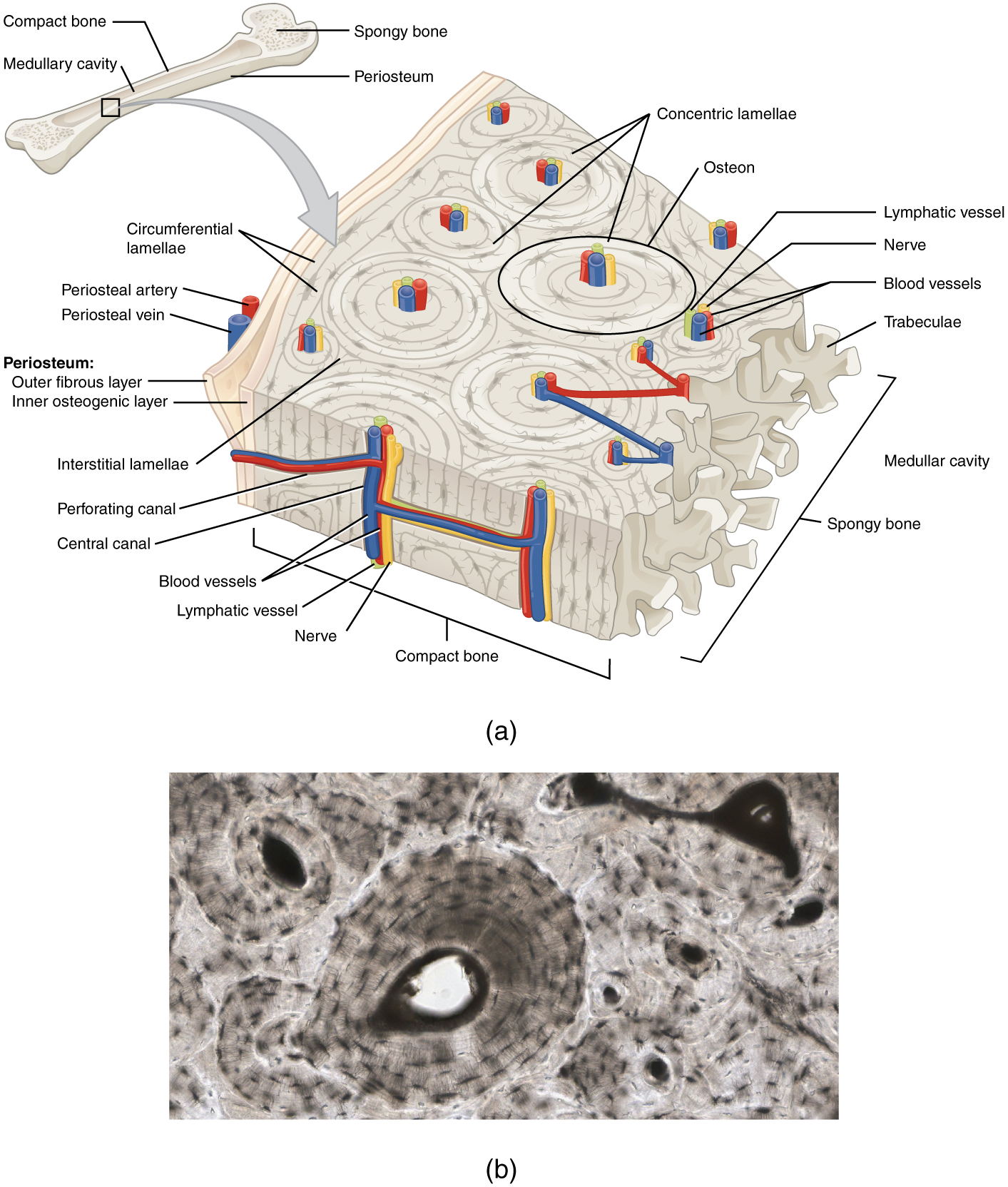
The microscopic structural unit of measurement of meaty bone is called an osteon, or Haversian system. Each osteon is composed of concentric rings of calcified matrix called lamellae (atypical = lamella). Running downwards the center of each osteon is the cardinal canal, or Haversian canal, which contains blood vessels, nerves, and lymphatic vessels. These vessels and nerves branch off at right angles through a perforating canal, also known equally Volkmann's canals, to extend to the periosteum and endosteum.
The osteocytes are located inside spaces called lacunae (singular = lacuna), found at the borders of adjacent lamellae. As described earlier, canaliculi connect with the canaliculi of other lacunae and eventually with the central canal. This system allows nutrients to exist transported to the osteocytes and wastes to be removed from them.
Spongy (Cancellous) Bone
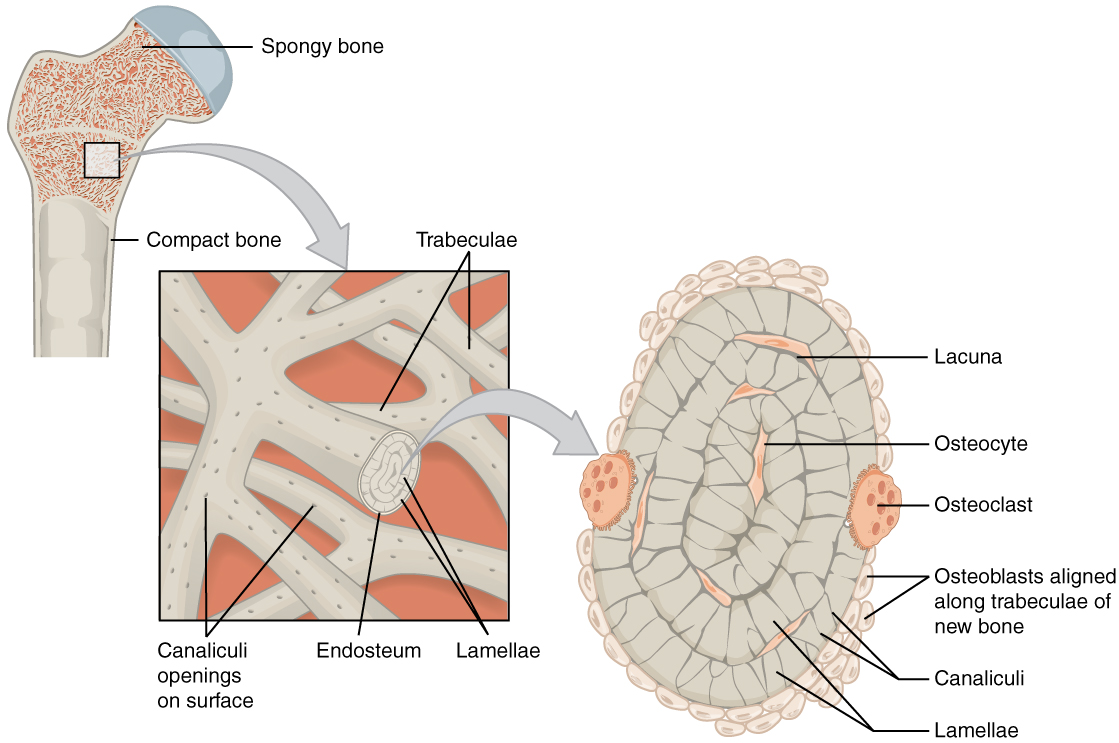
Like compact bone, spongy os, as well known as cancellous bone, contains osteocytes housed in lacunae, merely they are non arranged in concentric circles. Instead, the lacunae and osteocytes are found in a lattice-similar network of matrix spikes chosen trabeculae (singular = trabecula) ((Figure)). The trabeculae may announced to be a random network, simply each trabecula forms along lines of stress to provide forcefulness to the bone. The spaces of the trabeculated network provide residuum to the dense and heavy compact bone by making basic lighter so that muscles can move them more hands. In add-on, the spaces in some spongy bones contain cherry marrow, protected by the trabeculae, where hematopoiesis occurs.
Diagram of Spongy Bone
Spongy bone is equanimous of trabeculae that contain the osteocytes. Red marrow fills the spaces in some bones.
Aging and the…
Skeletal Organisation: Paget'south Disease Paget's illness usually occurs in adults over age twoscore. Information technology is a disorder of the os remodeling process that begins with overactive osteoclasts. This means more bone is resorbed than is laid downwardly. The osteoblasts effort to compensate but the new bone they lay downwards is weak and breakable and therefore prone to fracture.
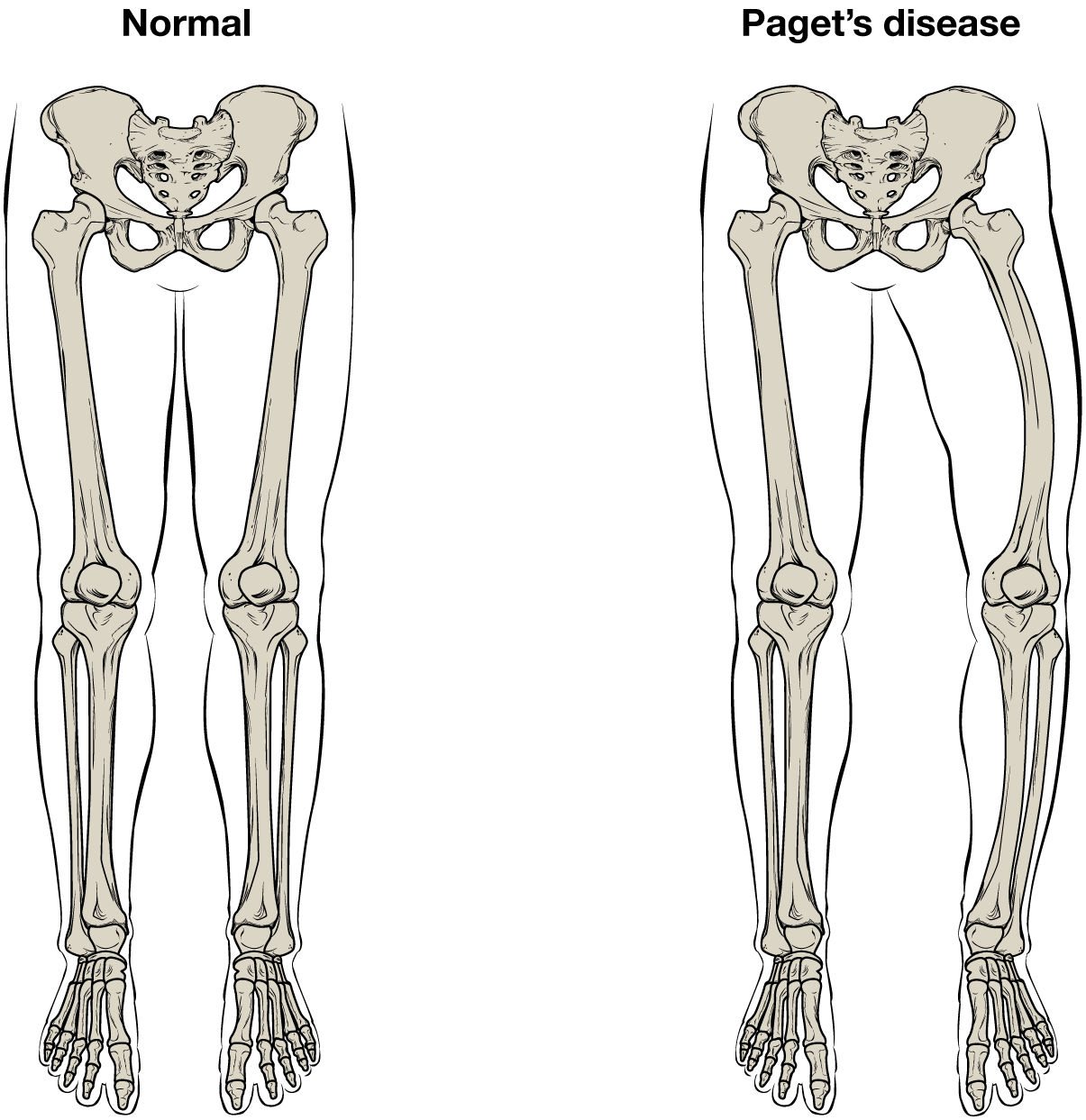
While some people with Paget'south affliction accept no symptoms, others experience pain, bone fractures, and bone deformities ((Figure)). Basic of the pelvis, skull, spine, and legs are the most unremarkably affected. When occurring in the skull, Paget's disease tin can cause headaches and hearing loss.
Paget's Illness
Normal leg basic are relatively directly, but those affected by Paget'due south disease are porous and curved.
What causes the osteoclasts to become overactive? The answer is yet unknown, only hereditary factors seem to play a role. Some scientists believe Paget'south disease is due to an as-yet-unidentified virus.
Paget's disease is diagnosed via imaging studies and lab tests. 10-rays may show bone deformities or areas of os resorption. Bone scans are also useful. In these studies, a dye containing a radioactive ion is injected into the body. Areas of bone resorption have an analogousness for the ion, and so they volition light upward on the scan if the ions are captivated. In addition, blood levels of an enzyme called alkaline phosphatase are typically elevated in people with Paget's illness.
Bisphosphonates, drugs that decrease the activeness of osteoclasts, are often used in the handling of Paget's disease. However, in a pocket-size percentage of cases, bisphosphonates themselves have been linked to an increased risk of fractures because the old bone that is left afterwards bisphosphonates are administered becomes worn out and brittle. Still, most doctors feel that the benefits of bisphosphonates more than than outweigh the chance; the medical professional has to weigh the benefits and risks on a case-past-example basis. Bisphosphonate treatment can reduce the overall adventure of deformities or fractures, which in turn reduces the risk of surgical repair and its associated risks and complications.
Blood and Nerve Supply
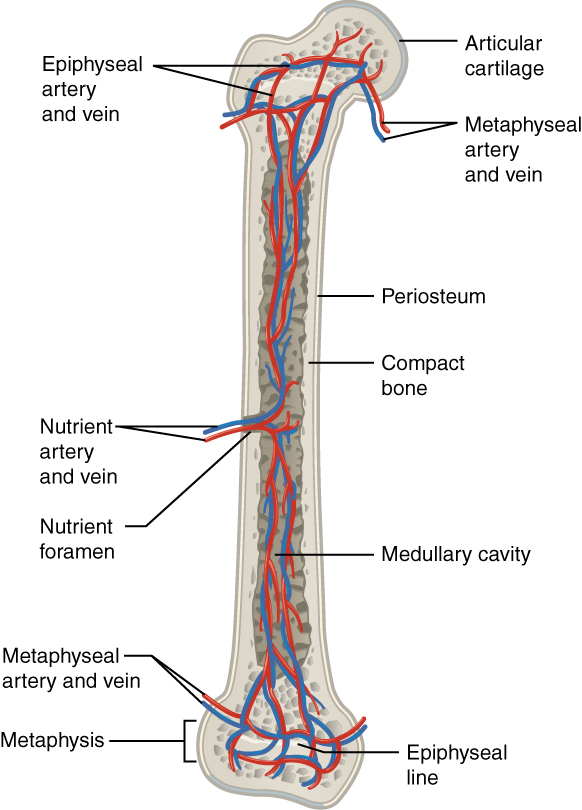
The spongy bone and medullary cavity receive nourishment from arteries that laissez passer through the compact bone. The arteries enter through the food foramen (plural = foramina), minor openings in the diaphysis ((Effigy)). The osteocytes in spongy os are nourished by blood vessels of the periosteum that penetrate spongy os and blood that circulates in the marrow cavities. Equally the blood passes through the marrow cavities, information technology is nerveless by veins, which and so pass out of the bone through the foramina.
In addition to the blood vessels, nerves follow the same paths into the bone where they tend to concentrate in the more metabolically agile regions of the os. The nerves sense pain, and information technology appears the fretfulness likewise play roles in regulating claret supplies and in bone growth, hence their concentrations in metabolically active sites of the os.
Diagram of Blood and Nerve Supply to Bone
Blood vessels and nerves enter the bone through the nutrient foramen.
Watch this video to meet the microscopic features of a bone.
Chapter Review
A hollow medullary crenel filled with yellow marrow runs the length of the diaphysis of a long bone. The walls of the diaphysis are meaty bone. The epiphyses, which are wider sections at each end of a long os, are filled with spongy bone and ruby-red marrow. The epiphyseal plate, a layer of hyaline cartilage, is replaced past osseous tissue every bit the organ grows in length. The medullary cavity has a delicate membranous lining chosen the endosteum. The outer surface of bone, except in regions covered with articular cartilage, is covered with a fibrous membrane chosen the periosteum. Flat basic consist of 2 layers of meaty bone surrounding a layer of spongy bone. Bone markings depend on the function and location of bones. Articulations are places where two bones run into. Projections stick out from the surface of the bone and provide attachment points for tendons and ligaments. Holes are openings or depressions in the basic.
Bone matrix consists of collagen fibers and organic ground substance, primarily hydroxyapatite formed from calcium salts. Osteogenic cells develop into osteoblasts. Osteoblasts are cells that make new bone. They get osteocytes, the cells of mature bone, when they get trapped in the matrix. Osteoclasts appoint in bone resorption. Compact bone is dumbo and composed of osteons, while spongy bone is less dumbo and made up of trabeculae. Blood vessels and nerves enter the bone through the nutrient foramina to nourish and innervate bones.
Review Questions
Which of the following occurs in the spongy bone of the epiphysis?
- bone growth
- bone remodeling
- hematopoiesis
- shock absorption
The diaphysis contains ________.
- the metaphysis
- fat stores
- spongy bone
- compact bone
The fibrous membrane covering the outer surface of the bone is the ________.
- periosteum
- epiphysis
- endosteum
- diaphysis
Which of the following are incapable of undergoing mitosis?
- osteoblasts and osteoclasts
- osteocytes and osteoclasts
- osteoblasts and osteocytes
- osteogenic cells and osteoclasts
Which cells do not originate from osteogenic cells?
- osteoblasts
- osteoclasts
- osteocytes
- osteoprogenitor cells
Which of the following are plant in compact bone and cancellous os?
- Haversian systems
- Haversian canals
- lamellae
- lacunae
Which of the following are only plant in cancellous os?
- canaliculi
- Volkmann'southward canals
- trabeculae
- calcium salts
The surface area of a bone where the nutrient foramen passes forms what kind of os marking?
- a hole
- a facet
- a culvert
- a scissure
Disquisitional Thinking Questions
If the articular cartilage at the end of ane of your long bones were to degenerate, what symptoms do you recall you would experience? Why?
If the articular cartilage at the terminate of one of your long basic were to deteriorate, which is actually what happens in osteoarthritis, you would experience joint pain at the terminate of that bone and limitation of motion at that joint because at that place would be no cartilage to reduce friction betwixt adjacent basic and there would be no cartilage to human action equally a shock absorber.
In what means is the structural makeup of compact and spongy bone well suited to their respective functions?
The densely packed concentric rings of matrix in compact bone are platonic for resisting compressive forces, which is the function of compact os. The open up spaces of the trabeculated network of spongy bone allow spongy os to support shifts in weight distribution, which is the function of spongy bone.
Glossary
- articular cartilage
- sparse layer of cartilage covering an epiphysis; reduces friction and acts as a shock absorber
- joint
- where two bone surfaces meet
- canaliculi
- (singular = canaliculus) channels within the bone matrix that house one of an osteocyte'south many cytoplasmic extensions that information technology uses to communicate and receive nutrients
- central canal
- longitudinal channel in the center of each osteon; contains claret vessels, fretfulness, and lymphatic vessels; also known as the Haversian culvert
- meaty os
- dumbo osseous tissue that can withstand compressive forces
- diaphysis
- tubular shaft that runs betwixt the proximal and distal ends of a long bone
- diploë
- layer of spongy bone, that is sandwiched between two the layers of compact bone found in apartment bones
- endosteum
- delicate membranous lining of a os'south medullary cavity
- epiphyseal plate
- (likewise, growth plate) canvas of hyaline cartilage in the metaphysis of an young bone; replaced by bone tissue as the organ grows in length
- epiphysis
- wide section at each end of a long os; filled with spongy bone and red marrow
- pigsty
- opening or depression in a bone
- lacunae
- (singular = lacuna) spaces in a bone that firm an osteocyte
- medullary cavity
- hollow region of the diaphysis; filled with yellow marrow
- food foramen
- small opening in the middle of the external surface of the diaphysis, through which an avenue enters the bone to provide nourishment
- osteoblast
- cell responsible for forming new os
- osteoclast
- jail cell responsible for resorbing bone
- osteocyte
- primary jail cell in mature bone; responsible for maintaining the matrix
- osteogenic prison cell
- undifferentiated jail cell with high mitotic activeness; the merely bone cells that split; they differentiate and develop into osteoblasts
- osteon
- (also, Haversian system) basic structural unit of compact bone; made of concentric layers of calcified matrix
- perforating culvert
- (as well, Volkmann'southward canal) channel that branches off from the central culvert and houses vessels and fretfulness that extend to the periosteum and endosteum
- periosteum
- fibrous membrane covering the outer surface of bone and continuous with ligaments
- projection
- os markings where part of the surface sticks out to a higher place the residuum of the surface, where tendons and ligaments attach
- spongy bone
- (likewise, cancellous os) trabeculated osseous tissue that supports shifts in weight distribution
- trabeculae
- (atypical = trabecula) spikes or sections of the lattice-like matrix in spongy bone
Source: https://opentextbc.ca/anatomyandphysiologyopenstax/chapter/bone-structure/
Posted by: brooksthenat1986.blogspot.com
0 Response to "What Are Reptile Bones Made Of What Is The Chemical Makeup Of Bone"
Post a Comment